When Condé Nast Plans for Zero Search Traffic, Your Brand Should Be Paying Attention
- JIaying Lu
- May 14
- 5 min read

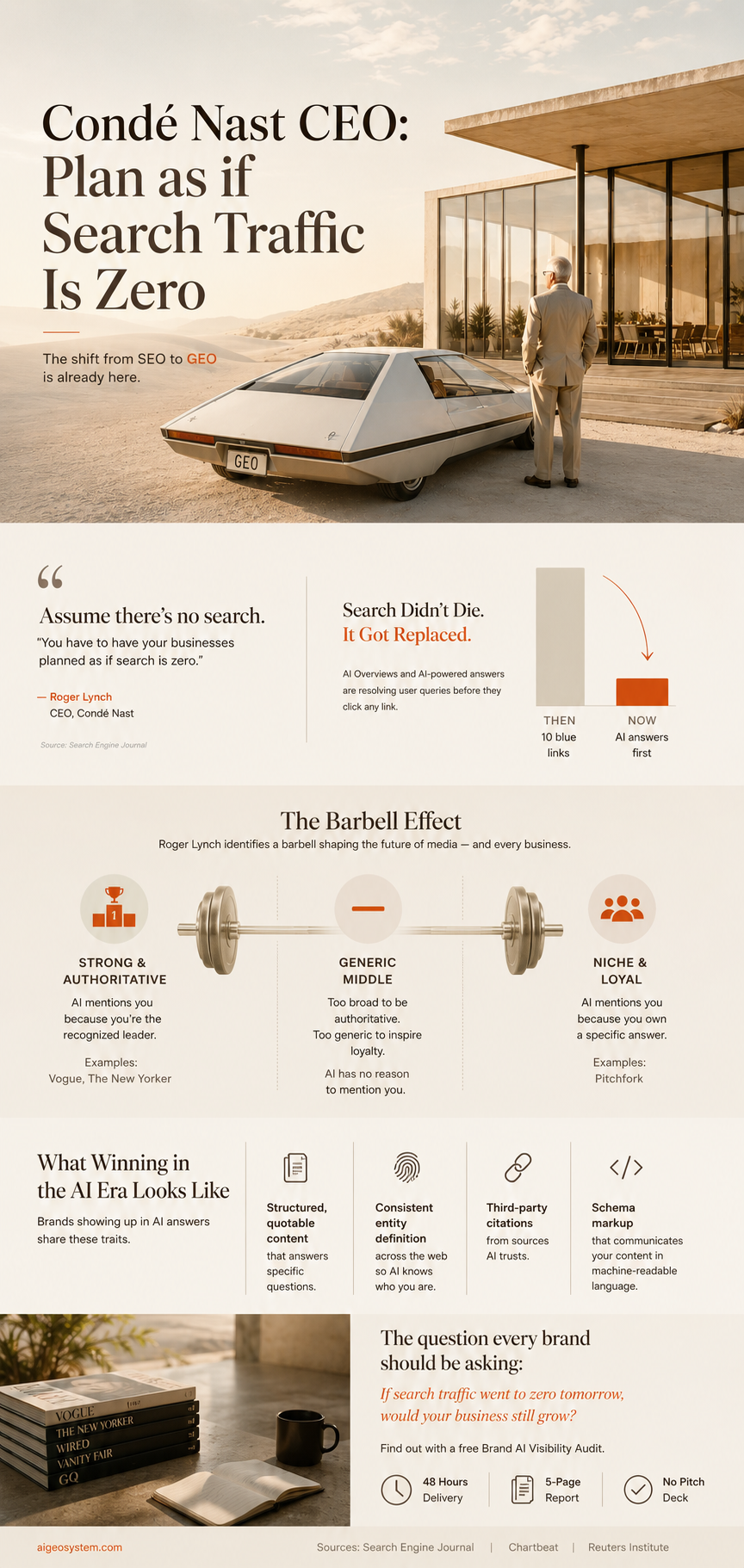
Roger Lynch, CEO of Condé Nast — the company behind Vogue, The New Yorker, GQ, Wired, and Vanity Fair — just said something that should stop every brand marketer cold.
In a recent interview on TBPN (the tech talk show acquired by OpenAI in April), Lynch revealed that he told his teams to budget as if search traffic is zero.
Not declining. Not shrinking. Zero.
"Each of the last three years, we would do our budgets and put in forecasts of search traffic declining. And every year, our search traffic was down more than we had forecast. So last year I told our teams: assume there's no search. You have to have your businesses planned as if search is zero." — Roger Lynch, CEO, Condé Nast (source: Search Engine Journal)
If one of the most powerful media companies on earth — with titles that have defined culture for decades — is planning for a world without search traffic, what does that mean for your brand?
Search Didn't Die. It Got Replaced.
Lynch didn't say search is dead. He said it's becoming irrelevant as a traffic source — and the data backs him up.
His team pulled a comparison for a recent board meeting: a Google search results page from seven or eight years ago versus today. The old page had a few sponsored links, then ten blue organic results. Today's page has an AI Overview at the top, then rows of commerce links, then sponsored content. Organic results? Buried.
Lynch put it bluntly: "I basically have to go to the second page to get an organic result."
Third-party data confirms the trend. Chartbeat reported that search referral traffic fell 60% for small publishers over two years. A Reuters Institute survey found media leaders expect search traffic to fall more than 40% over the next three years.
This isn't a Google algorithm update. It's a structural shift in how people find information — and it has a name.
The Shift Is from SEO to GEO
When someone types a question into ChatGPT, Perplexity, or Google's AI Overview today, they don't get a list of links. They get an answer. A synthesized, confident, conversational answer — with a handful of brand mentions baked in.
The brands that get mentioned in those answers aren't there by accident. They're there because they built their digital presence to be found and understood by AI — not just indexed by a search crawler.
This is Generative Engine Optimization (GEO) — the practice of structuring your brand's content, entity definition, and third-party presence so that AI systems can accurately represent you in their answers.
Search Engine Optimization was about ranking in a list. GEO is about being included in an answer.
Those are completely different games.
The Barbell That Lynch Described — And Why It Matters for You
Lynch identified what he called a "barbell effect" across the Condé Nast portfolio.
On one end: large, authoritative brands with deep category credibility. Vogue grows revenue every year. The New Yorker had its most successful year ever.
On the other end: small niche publications with loyal direct audiences. Pitchfork represents just 1% of Condé Nast's revenue but has a fiercely loyal audience in music.
In the middle: brands that are too broad to be authoritative, too generic to inspire loyalty. Lynch was direct about their future: "If you don't have really strong authoritative brands, or brands that have very strong niche in certain areas, or direct audiences, then you're just going to be fighting that all the way down."
This barbell isn't unique to media. It applies to every business that relied on search traffic to bring in new customers.
Big + authoritative → AI mentions you because you're the recognized leader
Small + niche + loyal → AI mentions you because you own a specific answer
Generic middle → AI has no reason to mention you at all
Where does your brand sit on that barbell?
What Winning in the AI Era Actually Looks Like
The brands appearing in AI-generated answers share a common profile. They don't just have websites — they have structured, quotable content that answers specific questions directly. They have consistent entity definitions across the web so AI can accurately identify what they do and who they serve. They have third-party citations from sources AI trusts. And they have schema markup that communicates their content in machine-readable language.
This is precisely what Condé Nast's top-performing titles have built over decades — authoritative, structured, widely-cited content with loyal direct audiences.
The difference is: you don't need decades. GEO can compress that timeline significantly if you build deliberately.
We Tested This on Ourselves First
At aigeosystem.com, we didn't start by selling GEO services. We started by running the audit on ourselves.
We searched for "GEO agencies" and "AI search optimization" across ChatGPT, Perplexity, and Google's AI Overview.
We weren't there.
So we applied the same framework we use for clients: restructured our content for AI parsing, built a clear entity definition, established third-party citations, implemented FAQ schema, and cleaned up our brand signals across the web.
Then we ran the test again.
We showed up.
That's the only pitch we need to make. We eat our own cooking — and we document every step so you can see exactly what changed.
The Question Lynch's Statement Forces You to Ask
If a Condé Nast brand can lose search traffic despite decades of authority and global recognition — what is your brand's plan for the same scenario?
Lynch's teams are now being evaluated on whether they can show "a path forward without search traffic." He's prioritizing brands that can demonstrate direct audience relationships, subscription revenue, and AI-era visibility.
Every brand should be running that same evaluation right now.
FAQ: GEO and the Zero-Search Future
What is GEO (Generative Engine Optimization)? GEO is the practice of optimizing your brand's digital presence to appear in AI-generated answers from tools like ChatGPT, Perplexity, Google AI Overview, and Claude. Unlike traditional SEO, which targets search rankings, GEO targets inclusion in synthesized AI responses.
Why is search traffic declining so fast? AI Overviews and AI-powered answers are resolving user queries before they click any link. Google's own data shows that 47% of searches now trigger an AI Overview. When users get an answer from AI, they have less reason to visit individual websites.
Is SEO dead? Not completely — but it is no longer sufficient on its own. Search still drives some traffic, particularly for transactional and local queries. But for informational and discovery queries, AI-generated answers are increasingly intercepting traffic that used to go to organic results. Brands need both SEO and GEO.
What does the "barbell effect" mean for small brands? Small brands with highly specific niches and loyal audiences can win in the AI era by owning a precise topic area. AI systems do recommend niche-specific brands when those brands have clear, well-structured, authoritative content in their category. The risk is in the generic middle — brands that are too broad to be authoritative, too vague to be recommended.
How do I know if my brand is visible on AI search? Run this test: open ChatGPT and search for your product or service category. Note which brands appear. If your competitors appear and you don't, you have an AI visibility gap. A Brand AI Visibility Audit gives you a complete picture: your current score, which competitors appear instead of you, and the specific structural gaps blocking your brand.
Next Step
Condé Nast is a $4 billion media empire and their CEO is planning for zero search traffic.
You don't need to wait three years of forecasts to start preparing.
We're running free Brand AI Visibility Audits this month — a 9-point diagnostic that shows you exactly where your brand stands on AI search and what needs to change.
48 hours. 5-page report. No pitch deck.
Sources: Search Engine Journal — Condé Nast CEO: Plan As If Search Traffic Will Be Zero | Chartbeat Search Referral Traffic Data | Reuters Institute Publisher Survey
Comments